
Why Sad After Giving Birth? Understand Postpartum Depression Causes Correctly to Stop Blaming Yourself | Safe and Sound
Giving birth is considered one of the happiest moments in life. Relatives offer congratulations, flowers and gifts pour in, and everyone around is beaming. But inside, many mothers are experiencing the complete opposite.
Postpartum depression doesn't occur because the mother is weak, ungrateful, or lacks sufficient love. The causes of postpartum depression are a complex mix of biological, psychological, and situational factors, and no one can completely control them. Understanding these causes is the first step in stopping self-blame and finding the right support.
The causes of postpartum depression are not solely "hormonal."
When asked about the causes of postpartum depression, the most common answer is, "It's just hormonal changes." That's true, but it's not the whole story. And because it's not the whole story, many mothers continue to feel confused even when their hormones have stabilized, but the heavy feeling persists.
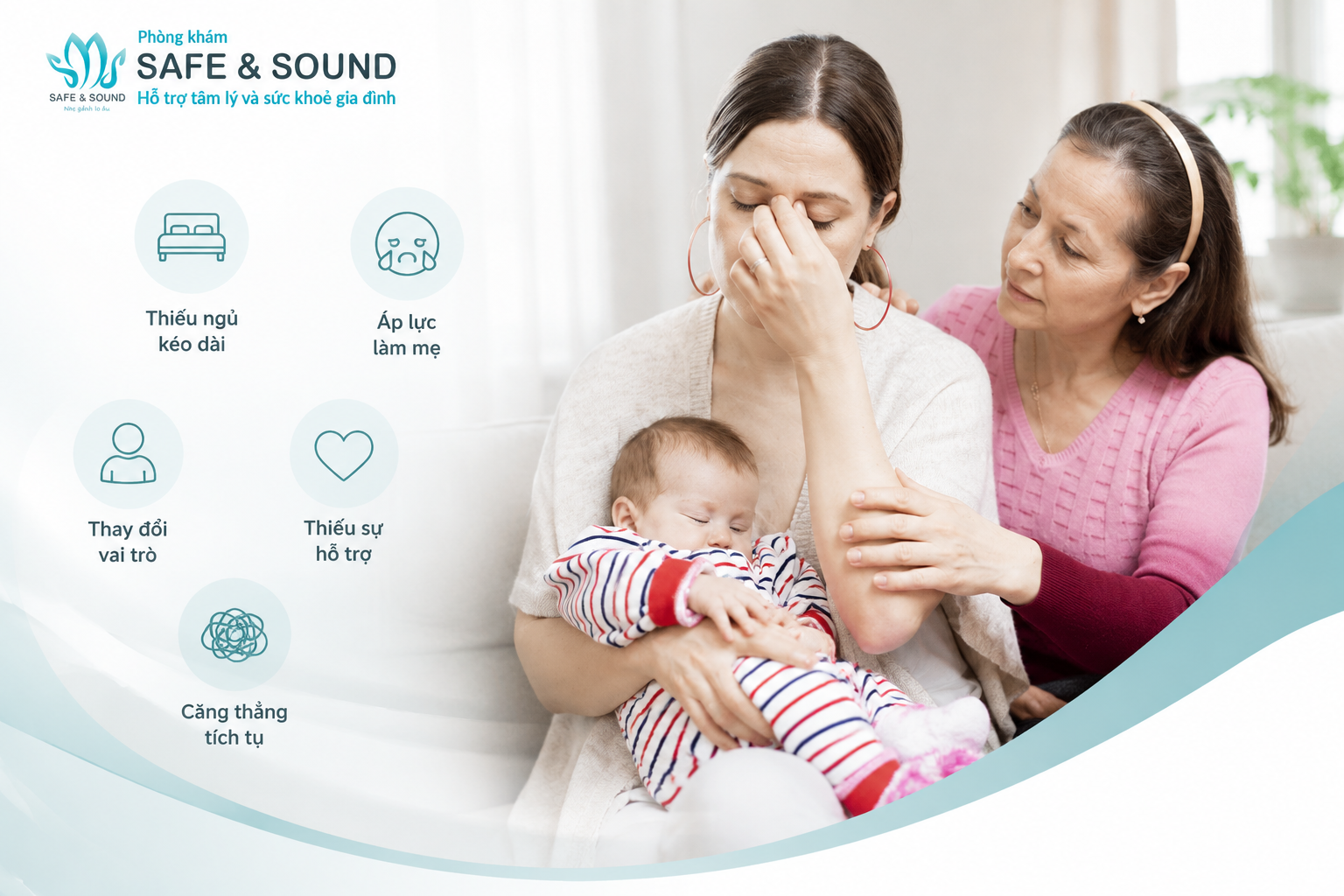 1. How do hormonal changes after childbirth affect the brain?
Throughout pregnancy, a woman's body maintains very high levels of estrogen and progesterone, many times higher than normal. Immediately after childbirth, these two hormones drop abruptly and rapidly within 24 to 48 hours.
This sudden change directly impacts neurotransmitters in the brain, particularly serotonin and dopamine, two substances closely linked to feelings of happiness, motivation, and emotional stability. When the levels of these substances are affected, the brain needs time to rebalance, and during that time, emotions can become unstable in ways the mother cannot control.
This is not something the mother inflicts upon herself. This is something that happens inside her body, completely against her will.
2. Why do not all women experience postpartum depression despite having similar hormonal changes?
This is a crucial question, and the answer will help break the "hormonal-only" notion once and for all. Every mother experiences hormonal changes after childbirth. But not everyone develops postpartum depression. That doesn't mean those who don't are "stronger" or "better" and those who do are "weaker" or "have problems."
Hormones are a fundamental biological factor, but many other factors determine who is more vulnerable during this period: mental health history, personality and emotional processing, support systems, living circumstances, and events that occur during and after pregnancy. Hormones trigger the process, but the full picture is much broader than that.
>> See also: Am I experiencing postpartum depression?
The causes of postpartum depression are often overlooked.
If we only look at hormones and lack of sleep, we're missing a lot of the story. Many deeper psychological and social factors, beyond what can be measured by blood tests, are what truly make postpartum depression last longer and be more severe in many mothers.
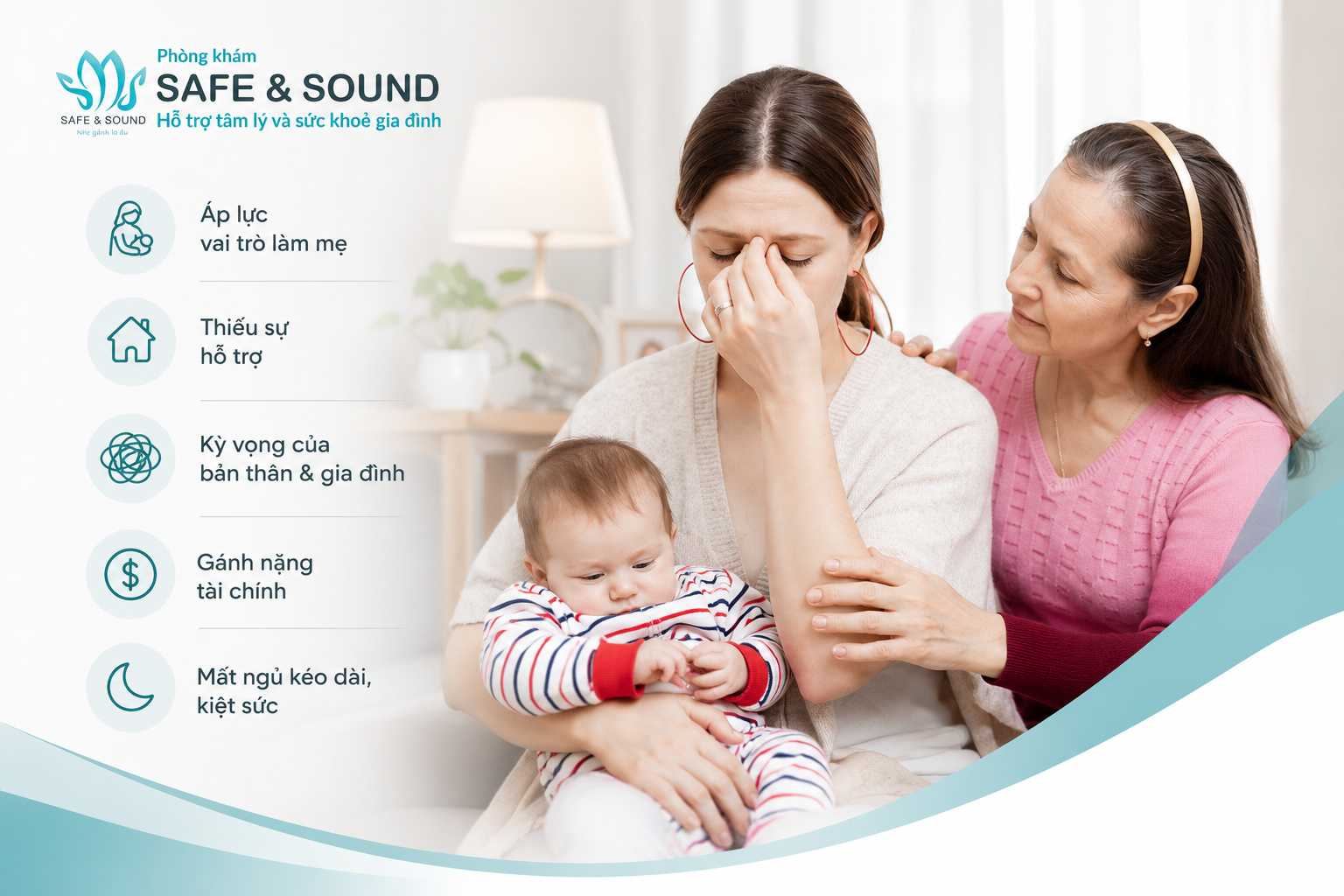 1. The gap between expectations and reality
Before giving birth, most of us have a certain image of motherhood: through movies, social media, and stories from those around us. The most common image is that of a happy, calm, natural mother who knows how to care for her child and is always full of love.
But the reality of the first few weeks after giving birth is often very different. Breastfeeding can be painful and difficult. Sleep is completely disrupted. The body hasn't recovered. There are times when you hold your baby and don't know what they need. There are times when you feel you don't love your baby as much as you thought you would.
When reality is vastly different from expectations, many mothers don't think, "This reality is harder than I imagined," but rather, "There must be something wrong with me." That gap, coupled with the invisible pressure of the "perfect mother" image, becomes a silent source of self-blame and prolonged sadness.
2. Losing personal identity after becoming a mother.
This is the least talked-about cause, yet it's something many mothers feel acutely, even if they don't know how to name it.
Before giving birth, a woman has a job, hobbies, habits, friends, and personal life. After giving birth, all of that gradually gives way to a single role: motherhood. In conversations, people ask about the child, not about her. Time for herself almost disappears. Even the way others address her changes, from her given name to "the child's mother."
There's nothing wrong with this shift, but when it happens too quickly and too drastically, it can create a profound sense of loss. A loss of self. A loss of knowing who you are beyond the role of a mother. And that's a real psychological cause—not selfishness, not a sign of a "not-good enough" mother.

3. Loneliness even in a large family.
This is a paradox many mothers experience but dare not speak out about, for fear of being misunderstood as ungrateful. They are not alone. They have grandparents to help care for their children. They have a husband by their side. They have relatives who visit regularly. But deep down, they still feel profoundly lonely.
Because most conversations revolve around the child: whether they've eaten, how many hours they've slept, and how much weight they've gained. It's rare for anyone to ask, "How are you?" And when they do try to express difficult feelings, the response is usually generic encouragement or a quick shift back to the child.
That loneliness isn't about a lack of people but rather a lack of genuine emotional connection. And when prolonged, it can significantly contribute to postpartum depression.
Who is more susceptible to postpartum depression?
Some mothers are at higher risk than others, not because they are weaker, but because they are carrying a greater burden during the same period.
Risk factors include a history of depression or anxiety (including during pregnancy), being a first-time mother with many unknowns and unfamiliar things, a difficult pregnancy or delivery, lack of genuine support from a partner or family, economic pressure or unstable living circumstances, and major events occurring during or immediately after pregnancy such as job loss, family conflict, or the death of a loved one.
It's important to understand that having many risk factors doesn't guarantee postpartum depression. Conversely, the absence of any risk factors doesn't mean complete immunity. Postpartum depression can occur in any mother, even those with the best external conditions.
Why understand the causes of postpartum depression?
Many readers might be wondering, "Now that I know the cause, what can I change?" The answer is yes, and this is why understanding it correctly is so important.
Once a mother understands the biological causes, she can stop asking herself, "Why am I like this?" and begin to see what is happening to her as an explainable reaction, not a mistake, not a failure.
By understanding the psychological causes, families can change their approach to support: from simply caring for the baby to genuinely asking about and listening to the mother. Sometimes, a sincere question like, "How are you?" is worth far more than saying, "All mothers feel this way after giving birth: "It's normal!"
And by understanding the risk factors, both mothers and their families can recognize earlier when to seek professional help instead of waiting until the situation has become too severe.
>> See also: Helping postpartum women overcome depression: the importance of professional mental health support
When Do the Causes of Postpartum Depression Begin to "Activate"?
One of the things that makes postpartum depression difficult to recognize is that it doesn't appear at a fixed time. Some mothers begin to feel unwell in the first few days after giving birth. Others seem stable for the first two months and then suddenly break down in the third month. Some don't even realize they're experiencing postpartum depression until their baby is almost a year old. That difference isn't random; it's directly related to how the causes accumulate and combine over time.
Instead of a single cause flipping a switch, postpartum depression is often the result of multiple factors simultaneously reaching a person's breaking point. The sudden hormonal changes immediately after childbirth are the biological basis.
But whether that foundation becomes a serious problem depends on what happens next: whether the mother gets enough sleep, whether she's listened to, whether she's shouldering everything alone, and whether she's trying to meet too many people's expectations at once. Understanding each stage and what typically happens within it helps both the mother and the family recognize earlier when attention is needed.
|
Stage |
This often happens. |
Easily triggered factors |
|
Weeks 1 to 2 |
Hormones drop most sharply, the body hasn't recovered, and sleep is completely disrupted. |
Severe sleep deprivation, lack of support, difficult labor, or postpartum complications. |
|
February to April |
Family support gradually diminished, and the mother began to care for her child more often on her own. |
Loneliness increased, the loss of personal identity became more apparent, and no one truly checked on the mother. |
|
From June onwards |
Many mothers return to work, new pressures arise, and some begin weaning. |
The guilt of leaving your child, the pressure of balancing work and motherhood, and hormonal changes during weaning. |
Looking at the table above, one thing is clear: there is no "absolutely safe" period, and no period is "too late to realize." Each stage brings its own pressures, and when many factors arise simultaneously without sufficient support, the risk of postpartum depression begins to increase significantly.
The only thing that really makes a difference is not forcing yourself to continue suffering alone when you've realized things aren't right. Whether symptoms start in the first week or the tenth month after birth, the condition can still be properly recognized and effectively supported when you seek help in the right place at the right time.
Conclude
"Why are you sad after giving birth?" is not a judgmental question. It's a very human question, asked by mothers trying to understand what's happening to them during one of the most beautiful yet challenging periods of their lives.
The causes of postpartum depression are not simple and don't lie in one place. They stem from the body, from psychology, from circumstances, and from all of those factors combined. None of these causes are the mother's fault. The important thing isn't to find someone to blame but to recognize that this is something that can happen, can be properly understood, and can be effectively addressed with the right support.
 At SNS (Safe & Sound Clinic), we understand that every mother has a unique story, and no story is "not serious enough" to be heard. If you're wondering if what you're going through is postpartum depression, we're here to help you find the answer without judgment or haste.
